Description
This track displays the ENCODE Registry of candidate cis-Regulatory Elements (cCREs)
in the mouse genome from ENCODE 4. A total of 926,843 elements were identified and classified by the
ENCODE Data Analysis Center according to biochemical signatures. Most cCREs are anchored on
DNase hypersensitive sites further annotated with histone modifications (H3K4me3 and H3K27ac)
or CTCF binding measured by ChIP-seq experiments. In this latest version of the Registry (V4),
the representative DNase hypersensitive sites (rDHSs) were supplemented
with 7,658 representative transcription factor ChIP-seq peaks (TF
rPeaks), which represent binding sites for at least five TFs. The Registry of cCREs is
one of the core components of the integrative level of the ENCODE Encyclopedia of DNA Elements.
Additional exploration of the cCREs and underlying raw ENCODE signal data can be done with the
Core Collection track. The data is also available on the SCREEN (Search Candidate cis-Regulatory
Elements) web tool, designed specifically for the Registry, accessible by item mouseovers and linkouts from the
track details page.
Display Conventions and Configurations
Each cCRE is color-coded by its classification type, which reflects its putative functional
assignment based on biochemical signatures and genomic context:
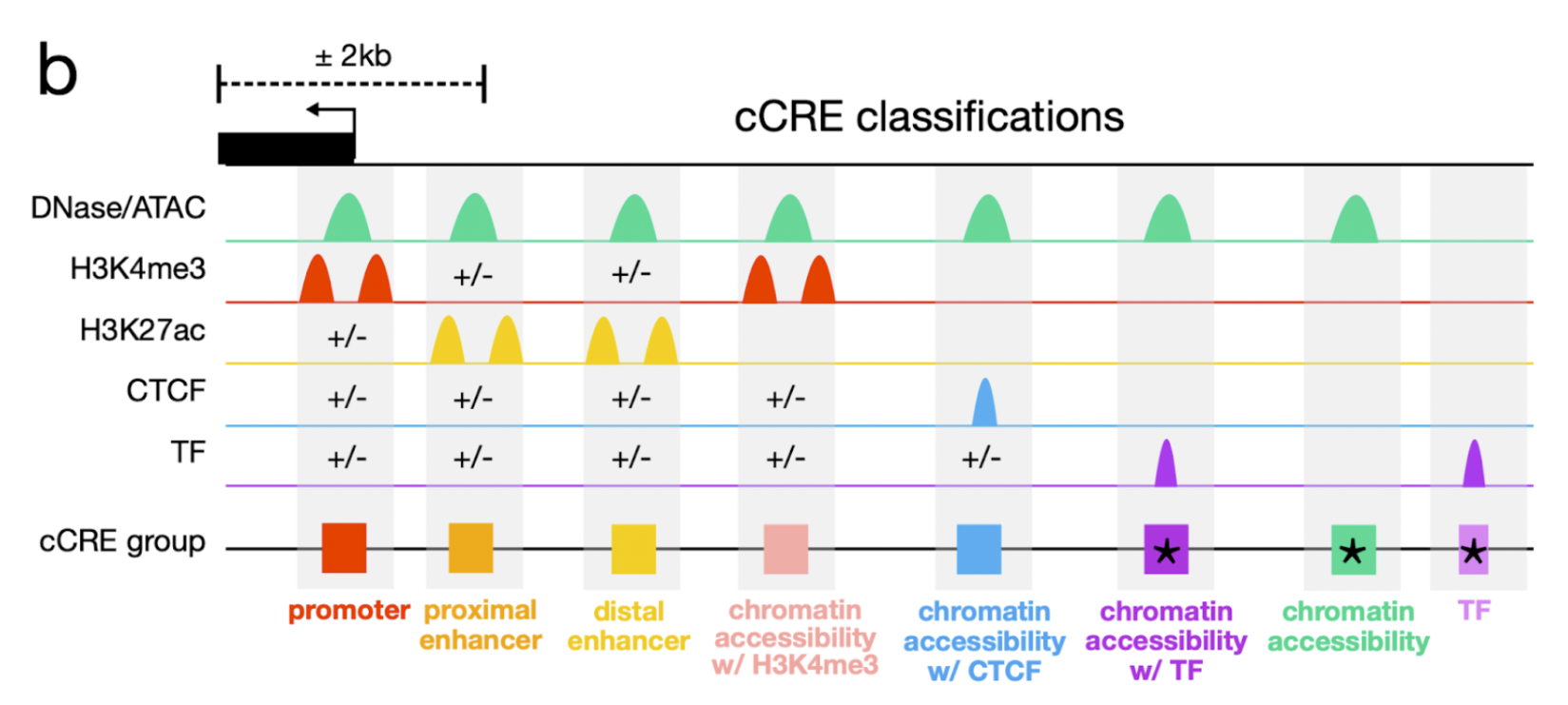
- Promoter-like signatures (promoter) in red
must fall within 200 bp of a TSS and have high chromatin accessibility and H3K4me3 signals.
- TSS-proximal enhancer-like signatures (proximal
enhancer) in orange
have high chromatin accessibility and H3K27ac signals and are
within 2 kb of an annotated TSS. If they are within 200 bp of a TSS, they must
also have low H3K4me3 signal.
- TSS-distal enhancer-like signatures
(distal enhancer) in yellow
have high chromatin accessibility and H3K27ac signals
and are farther than 2 kb from an annotated TSS.
- Chromatin accessibility +
H3K4me3 (CA-H3K4me3) in pink
have high chromatin accessibility and H3K4me3
signals but low H3K27ac signals and do not fall within 200 bp of a TSS.
- Chromatin accessibility +
CTCF (CA-CTCF) in blue
have high chromatin accessibility and CTCF signals
but low H3K4me3 and H3K27ac signals.
- Chromatin accessibility +
transcription factor (CA-TF) in dark purple
have high chromatin accessibility,
low H3K4me3, H3K27ac, and CTCF signals, and are bound by a transcription factor.
- Chromatin accessibility
(CA) in green
have high chromatin accessibility and low H3K4me3, H3K27ac, and
CTCF signals.
- Transcription factor
(TF) in light purple
have low chromatin accessibility, low H3K4me3, H3K27ac,
and CTCF signals and are bound by a transcription factor.
Mousing over an item displays the element ID with a linkout to SCREEN, the cCRE class,
and the max-Z scores for DNase, H3K4me3, H3K27ac, and CTCF. A max-Z score above 1.64 is
considered "high" signal, while a score of 1.64 or below is considered "low" signal
for classification purposes (Moore et al., 2026). A score of -10.00 indicates the assay was not
available in any surveyed biosample.
A track filter is also available
to selectively show items based on their cCRE class type.
Methods
Candidate cis-regulatory elements (cCREs) were first anchored on nucleosome-sized DNase
hypersensitive sites (rDHSs) identified from DNase-seq data. These rDHSs were then annotated
using ChIP-seq data for histone modifications (H3K4me3 and H3K27ac, marking promoters and
enhancers, respectively) and CTCF, marking insulators. To supplement rDHS-anchored cCRE
definitions, transcription factor ChIP-seq peaks were incorporated, enabling identification
of cCREs even in regions of low chromatin accessibility. Although not used for anchoring,
ATAC-seq data were used to assess chromatin accessibility in biosamples lacking DNase-seq.
Because ATAC-seq was not standardized across all biosamples, the ATAC max-Z score is not included
in the registry bigBed fields or mouseOver. Only the four core assays (DNase, H3K4me3, H3K27ac,
and CTCF) are reported as max-Z scores. ATAC-seq signal tracks are available in the
ENCODE4 Regulation track.
The following diagram illustrates the biochemical signal patterns used to classify each cCRE type:
Data Access
The ENCODE accession numbers of the constituent datasets at the ENCODE Portal are available from the cCRE details page.
The data in this track can be interactively explored with the Table Browser or the Data Integrator. The data can be accessed from
scripts through our API,
the track name is "cCREregistry".
For automated download and analysis, this annotation is stored in a bigBed file
that can be downloaded from our download server.
The file for this track is called encodeCcreRegistry.bb. Individual regions or the whole genome
annotation can be obtained using our tool bigBedToBed which can be compiled from the source
code or downloaded as a precompiled binary for your system. Instructions for downloading
source code and binaries can be found here.
The tool can also be used to obtain only features within a given range, e.g.
bigBedToBed http://hgdownload.soe.ucsc.edu/gbdb/mm10/encode4/ccre/encodeCcreRegistry.bb -chrom=chr1 -start=0 -end=100000000 stdout
Credits
Data were generated by the ENCODE Consortium. The data were further processed for
visualization through a collaborative effort between the Weng lab and the Moore lab at UMass Chan Medical
School (funded by NIH grant HG012343). Integration and visualization were developed
by Drs. Mingshi Gao, Jill Moore, and Zhiping Weng at UMass Chan Medical School, who were
part of the ENCODE Data Analysis Center. We thank the ENCODE production labs
for generating the data.
References
ENCODE Project Consortium, Moore JE, Purcaro MJ, Pratt HE, Epstein CB, Shoresh N, Adrian J, Kawli T,
Davis CA, Dobin A et al.
Expanded encyclopaedias of DNA elements in the human and mouse genomes.
Nature. 2020 Jul;583(7818):699-710.
PMID: 32728249; PMC: PMC7410828
Moore JE, Pratt HE, Fan K, Phalke N, Fisher J, Elhajjajy SI, Andrews G, Gao M, Shedd N, Fu Y et
al.
An Expanded Registry of Candidate cis-Regulatory Elements for Studying Transcriptional
Regulation.
Nature. 2026 January 7.
PMID: 39763870; PMC: PMC11703161